187 people are reading this right now | Launch price ends in: 02:47:33

Your House Already Knows
How to Stay Warm

Before the furnace salesman arrived, builders engineered heat retention into the structure itself. That engineering is still in your walls.

100+ Pages 25 Chapters PDF · Instant Download 30-Day Money-Back Guarantee
⸻ ⸻ ⸻
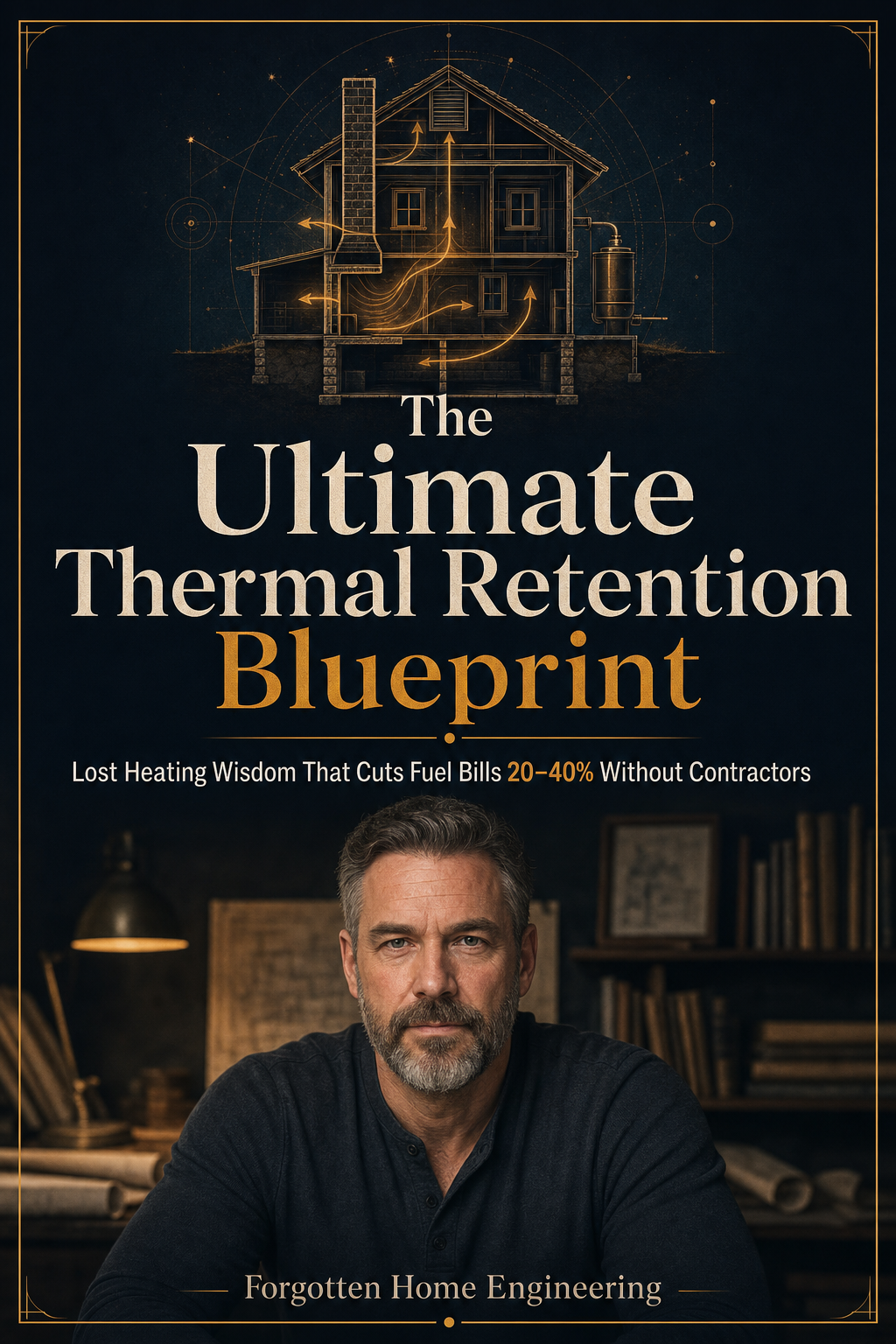
The Ultimate Thermal Retention Blueprint — ebook cover
100+ PAGES

The Ultimate Thermal Retention Blueprint

Your Pre-Modern Home Was Built to Stay Warm Without a Fuel Bill — Recover the Engineering the HVAC Industry Hopes You Never Find

$47
$80
SAVE $33
How to read your home's original thermal design before you spend a dollar on anything (Chapter 4 — "Reading the Bones")
The chimney draft physics that pre-modern families managed every morning — and that your thermostat has made invisible (Chapter 5)
Zone isolation: the room-by-room strategy that cut fuel use before central heating existed — using nothing but your interior doors (Chapter 7 & 8)
Window insulation using historical methods that outperform the film kits sold at every hardware store (Chapter 10)
The heat loss audit worksheet — a room-by-room tool that turns guesswork into a ranked repair list (Chapter 18)
What pre-modern builders did about cold floors and lost ceiling heat — structural methods, no contractor required (Chapters 13 & 14)
Get Instant Access — $47
✓ 30-Day Money-Back Guarantee ✓ Instant PDF Download ✓ No subscription

25 Chapters. One Complete System.

The chapters that will change how you read every room in your house.

CH.1
The First Hour: One Walk-Through That Changes Everything
One walk through your house — with the right eyes — reveals exactly where your heat is leaving and exactly where to start.
CH.3
Thermal Mass: The Stone Memory of Your House
Your walls, floors, and chimney stack store heat like a battery. Pre-modern builders counted on this. You can, too.
CH.5
The Chimney as an Engine: Draft Physics Every Homeowner Must Understand
A chimney doesn't just exhaust smoke — it actively pulls cold air through every crack in your house. Here is how to stop it.
CH.8
The Interior Door: The Most Underused Thermal Tool in Your House
You already own this tool. You walk past it twenty times a day. Pre-modern families built their entire heating strategy around it.
CH.10
Window Insulation Without Replacement: Historical Methods That Still Outperform Film Kits
Before the window replacement industry existed, people kept glass from killing their heat. The methods are still better than what hardware stores sell today.
CH.11
Finding the Invisible Draft: A Systematic Method for Locating Hidden Air Infiltration
Cold air doesn't announce itself. This systematic walk-through method finds it anyway — no blower door test required.
CH.16
The Morning Warm-Up Sequence: How Pre-Central-Heating Families Started the Day
They had a sequence. It worked in 1910. It works now. Most people have no idea this approach even existed.
CH.18
The Heat Loss Audit: A Room-by-Room Worksheet for Quantifying What You Are Losing
This worksheet is what separates a system from a list of suggestions. Fill it out once and you know exactly where your money is going.
CH.20
The Renter's Toolkit: Thermal Retention Without Landlord Permission
You cannot touch the walls. You cannot replace the windows. That still leaves you more leverage than you think — if you know where to look.
CH.22
Cooking and Domestic Heat: The Forgotten Thermal Contribution of Daily Life
Pre-modern households timed their cooking, laundry, and baking around the thermal calendar. You're already generating this heat — you're just not using it.

...and 15 more chapters covering damper control, attic sealing, ceiling retention, seasonal maintenance, measuring your results, and more.

The House Knew What the Contractor Didn't

There is a specific kind of frustration that comes from turning up the thermostat and still being cold. You have already paid for the heat. The furnace ran all night. And yet the bedroom is 58 degrees by morning, the living room has a draft that no caulk gun has ever killed, and the utility bill keeps arriving like a punishment for a crime you didn't commit.

The contractor's answer is always a bigger number. A new furnace. New windows — $12,000 installed. More insulation in the attic, quoted at prices that assume you have never done math. And sometimes those are the right answers. But often, the house is not broken. It is being run wrong. The thermal logic that was built into it — the chimney placement, the floor plan, the ceiling heights, the mass of the masonry — is still there. It is just being ignored, because nobody taught you to read it.

"They knew this in 1910. They knew it because fuel cost money and there was no utility company to call. The knowledge did not disappear — it just stopped being taught."

Forgotten Home Engineering started as a YouTube channel for people who had stopped believing the replacement mentality. Homeowners who sensed their old houses had more thermal intelligence than any salesman gave them credit for. People who wanted to understand the structure they already owned, not replace it with something they couldn't afford.

This book is the written system behind that work. It is not a collection of suggestions. It is a sequenced approach — starting with a walk-through, moving through a room-by-room audit, and ending with a ranked list of what to address first and how. The heat loss audit worksheet alone changes how you see every room. You stop guessing. You start measuring. And the number that comes back is almost always smaller than what a contractor quoted you.

Forgotten Home Engineering — author

Forgotten Home Engineering

Author · The Forgotten Blueprint

A YouTube channel and publishing project built around one idea: your older home was engineered to hold heat without a fuel bill, and that engineering is still recoverable. 2,000+ subscribers. No contractors. No sponsored content. Just the methods that worked before the HVAC industry existed.

Watch on YouTube

The $47 Price Doesn't Last

This is the introductory rate for the initial launch period. When this window closes, the price returns to $80.

Your next heating bill arrives whether you act or not.

02
Hours
:
47
Minutes
:
33
Seconds
Lock In $47 Before It Expires

What Staying the Same Actually Costs

In homes built before 1980, unaddressed air infiltration and poor thermal management routinely add 25-40% to the annual heating bill. Here is what that looks like in numbers you already know.

$180–$280
Average monthly heating cost in a poorly sealed 1,800 sq ft home — six-month heating season
$1,440+
What you pay every winter doing nothing differently — year after year after year
$47
Once. No subscription. No contractor. The blueprint that shows you what to fix first.

A 20% reduction in that fuel use pays for this book in the first month of the heating season. The contractor who quoted you $8,000 in new windows would rather you not think about it that way.

What Readers Found Inside

The following are composite reflections based on reader feedback and represent common experiences. Individual results vary.

"I own a 1954 cape cod and I've spent three winters fighting a cold bedroom above the garage. Two contractors told me I needed new insulation — one quoted $4,200, one said $6,500. I did the heat loss audit worksheet from Chapter 18 instead. Turned out the garage ceiling air sealing was where 60% of the loss was coming from. Forty dollars of materials later and the room holds temperature through the night for the first time since I bought this house. I feel like an idiot for not having this two years ago."

— Tom R., homeowner, Ohio

Pre-1960 cape cod, retired trades background

"I rent and my landlord has done exactly nothing about the drafts in this apartment. Chapter 20 on the Renter's Toolkit was worth the price by itself. I didn't know there were this many approaches that don't touch the walls or windows permanently. I spent about $30 and the living room is genuinely warmer. The morning crash that used to happen every night around 4am is gone. My heating bill dropped $45 in the first month. For a renter, that's real money."

— Sandra M., renter, Minnesota

Apartment in a 1940s building, first floor unit

"What I appreciated most is that this book never talks down to you and never tells you to call someone. Chapter 5 on chimney draft physics was something I had never heard explained that clearly — I didn't know my fireplace was actively pulling cold air in through the walls when the damper was open. Once I understood that, I stopped using the fireplace the way I had been and the furnace stopped short-cycling. Chapter 7 on zone isolation changed how I think about the whole house. I closed off two rooms we don't use and the rest of the house holds heat three hours longer on a cold night."

— Dave K., homeowner, rural Ontario

1968 two-story farmhouse, wood heat and propane

30 Day

30-Day Money-Back Guarantee

Read the book. Do the walk-through. Fill out the heat loss audit worksheet. If at the end of 30 days you don't feel you have a clearer, more actionable picture of your home's thermal situation than you did before — contact us and you get your money back. No questions. No explanation required. The risk is entirely ours.

Answered Directly

What exactly do I get?
A 100+ page PDF ebook delivered instantly to your inbox after purchase. 25 chapters, a heat loss audit worksheet you can print and use immediately, and permanent access — no subscription, no account required after download. You own it.
What if it's not for me?
Email us within 30 days and we refund you in full, no questions asked. You don't need a reason. You don't need to return anything — it's a digital file. The guarantee is real because we stand behind the material.
My house is newer — built in the 1980s or 1990s. Is this still relevant?
Yes. The thermal mass principles, zone isolation methods, chimney management, and air sealing approaches in this book apply to any home with a conventional structure. Homes built between 1950 and 2000 often have the worst of both worlds — thin thermal envelopes with none of the mass of older construction. The heat loss audit and the morning warm-up sequence work regardless of construction year.
Do I need any tools or technical background?
No special tools. No prior knowledge. The walk-through in Chapter 1 uses your hands, your eyes, and a candle or lighter. The heat loss audit worksheet is a printed sheet and a pen. The methods in this book were developed before power tools existed. If you can feel a draft, you can start immediately.
I rent. Is this still useful to me?
Chapter 20 — "The Renter's Toolkit" — covers exactly this. There are more thermal retention methods available to renters than most people realize. None of them require landlord permission, none of them damage the unit, and most cost under $40 in materials. The chapter also covers how to document and present the issue to a landlord if you decide to pursue that route.
Is this just a list of weatherstripping suggestions?
No. Weatherstripping is mentioned — it's a real tool — but this book covers the thermal engineering logic that pre-dates manufactured weatherstripping by centuries. Thermal mass management, chimney draft physics, zone isolation strategy, ceiling retention, morning warm-up sequencing — this is a system. The heat loss audit worksheet is what separates it from a list of suggestions. You measure first, then prioritize, then act. In that order.

The House Already Has
the Answer Built In

You are heating a thermally engineered structure as if it were a tent. The engineering is still there — in the chimney stack, in the floor plan, in the mass of the walls. This book is the flashlight. What you do with it is up to you.

Get Instant Access — $47
✓ 30-Day Money-Back Guarantee ✓ PDF · Instant Download ✓ One-time payment

Regular price $80  ·  Launch price $47  ·  Save $33

The Ultimate Thermal Retention Blueprint

100+ pages · Instant PDF Download · 30-Day Guarantee

?
Someone
just purchased The Thermal Retention Blueprint
2 minutes ago