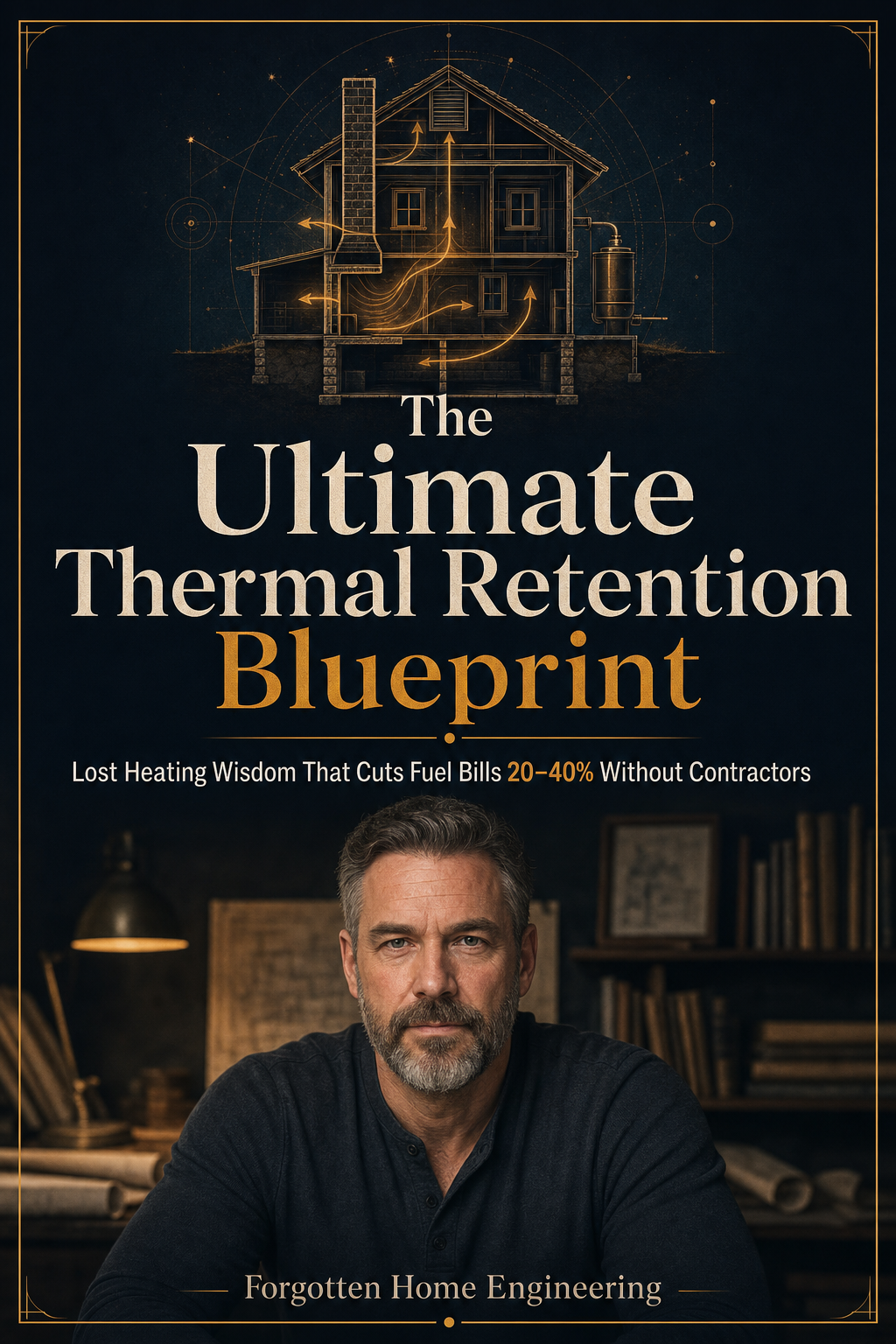
The Forgotten Blueprint
Before the furnace salesman arrived, builders engineered heat retention into the structure itself. That engineering is still in your walls.
The Forgotten Blueprint
Your Pre-Modern Home Was Built to Stay Warm Without a Fuel Bill — Recover the Engineering the HVAC Industry Hopes You Never Find
What's Inside
The chapters that will change how you read every room in your house.
...and 15 more chapters covering damper control, attic sealing, ceiling retention, seasonal maintenance, measuring your results, and more.
Why This Exists
There is a specific kind of frustration that comes from turning up the thermostat and still being cold. You have already paid for the heat. The furnace ran all night. And yet the bedroom is 58 degrees by morning, the living room has a draft that no caulk gun has ever killed, and the utility bill keeps arriving like a punishment for a crime you didn't commit.
The contractor's answer is always a bigger number. A new furnace. New windows — $12,000 installed. More insulation in the attic, quoted at prices that assume you have never done math. And sometimes those are the right answers. But often, the house is not broken. It is being run wrong. The thermal logic that was built into it — the chimney placement, the floor plan, the ceiling heights, the mass of the masonry — is still there. It is just being ignored, because nobody taught you to read it.
Forgotten Home Engineering started as a YouTube channel for people who had stopped believing the replacement mentality. Homeowners who sensed their old houses had more thermal intelligence than any salesman gave them credit for. People who wanted to understand the structure they already owned, not replace it with something they couldn't afford.
This book is the written system behind that work. It is not a collection of suggestions. It is a sequenced approach — starting with a walk-through, moving through a room-by-room audit, and ending with a ranked list of what to address first and how. The heat loss audit worksheet alone changes how you see every room. You stop guessing. You start measuring. And the number that comes back is almost always smaller than what a contractor quoted you.
Forgotten Home Engineering
Author · The Forgotten Blueprint
A YouTube channel and publishing project built around one idea: your older home was engineered to hold heat without a fuel bill, and that engineering is still recoverable. 2,000+ subscribers. No contractors. No sponsored content. Just the methods that worked before the HVAC industry existed.
Watch on YouTubeLaunch Pricing Ends Soon
This is the introductory rate for the initial launch period. When this window closes, the price returns to $80.
Your next heating bill arrives whether you act or not.
The Real Cost
In homes built before 1980, unaddressed air infiltration and poor thermal management routinely add 25-40% to the annual heating bill. Here is what that looks like in numbers you already know.
Reader Reflections
The following are composite reflections based on reader feedback and represent common experiences. Individual results vary.
"I own a 1954 cape cod and I've spent three winters fighting a cold bedroom above the garage. Two contractors told me I needed new insulation — one quoted $4,200, one said $6,500. I did the heat loss audit worksheet from Chapter 18 instead. Turned out the garage ceiling air sealing was where 60% of the loss was coming from. Forty dollars of materials later and the room holds temperature through the night for the first time since I bought this house. I feel like an idiot for not having this two years ago."
— Tom R., homeowner, Ohio
Pre-1960 cape cod, retired trades background
"I rent and my landlord has done exactly nothing about the drafts in this apartment. Chapter 20 on the Renter's Toolkit was worth the price by itself. I didn't know there were this many approaches that don't touch the walls or windows permanently. I spent about $30 and the living room is genuinely warmer. The morning crash that used to happen every night around 4am is gone. My heating bill dropped $45 in the first month. For a renter, that's real money."
— Sandra M., renter, Minnesota
Apartment in a 1940s building, first floor unit
"What I appreciated most is that this book never talks down to you and never tells you to call someone. Chapter 5 on chimney draft physics was something I had never heard explained that clearly — I didn't know my fireplace was actively pulling cold air in through the walls when the damper was open. Once I understood that, I stopped using the fireplace the way I had been and the furnace stopped short-cycling. Chapter 7 on zone isolation changed how I think about the whole house. I closed off two rooms we don't use and the rest of the house holds heat three hours longer on a cold night."
— Dave K., homeowner, rural Ontario
1968 two-story farmhouse, wood heat and propane
Read the book. Do the walk-through. Fill out the heat loss audit worksheet. If at the end of 30 days you don't feel you have a clearer, more actionable picture of your home's thermal situation than you did before — contact us and you get your money back. No questions. No explanation required. The risk is entirely ours.
Common Questions
One Last Thing
You are heating a thermally engineered structure as if it were a tent. The engineering is still there — in the chimney stack, in the floor plan, in the mass of the walls. This book is the flashlight. What you do with it is up to you.
Get Instant Access — $47Regular price $80 · Launch price $47 · Save $33
The Ultimate Thermal Retention Blueprint
100+ pages · Instant PDF Download · 30-Day Guarantee
Wait — One Second
You have 30 days to read every chapter, do the walk-through, run the heat loss audit worksheet, and decide whether this was worth it. If it wasn't — you get your money back, no explanation required. The only risk is paying your next heating bill the same way you paid the last one.